Signs Your Seawall Is Failing
Seawall failing? Pinellas County’s tidal conditions and sandy soil mean the damage moves faster than almost anywhere else in Florida. The signs of a failing seawall are easy to miss until the damage is already serious. By then, what started as a manageable repair has usually turned into a costly structural problem. The wall quietly does its job for decades, holding back tidal pressure, keeping your soil in place, protecting the foundation of everything behind it, has been telling you something was wrong for months. You just didn’t know what to look for.
Why Pinellas County Seawalls Are Under More Stress Than Almost Anywhere in Florida
Before getting into the warning signs, it’s worth understanding why seawalls here fail the way they do, because the local conditions are genuinely unusual.
Hurricane Helene’s storm surge overtopped the Gulf-side seawall in Madeira Beach by up to two feet and the bayside seawall by over four feet, pushing walls that were already showing wear past their breaking point. Total reported damage from Helene, Milton, and Debby in Pinellas County exceeded $2.4 billion, with Helene alone accounting for $2.1 billion and representing the worst storm to hit this coastline in nearly a century.
But the storm damage story is only part of it. Many Florida seawalls were built over 50 years ago when building standards were lower, and they’ve spent decades absorbing the compounding effects of salt corrosion, tidal action, boat wakes, storm surges, and heavy rain. Pinellas County’s sandy soil means water moves easily behind and beneath seawalls, building up the kind of hydrostatic pressure that concrete walls were never meant to handle indefinitely.
The result is a county where seawall problems are not exceptional. They’re expected. And where the homeowners who catch problems early spend a fraction of what those who wait end up paying.
What to Look For: The Warning Signs That Actually Matter
Cracking in the Wall Face or Seawall Cap
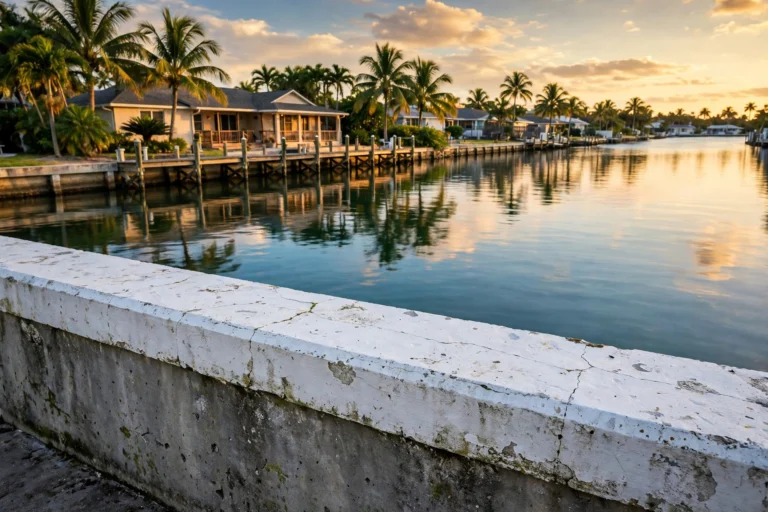
Not every crack means you’re in trouble, but knowing the difference matters. Small hairline cracks in a concrete seawall are normal as the material ages and contracts. They’re worth monitoring but not cause for immediate panic.
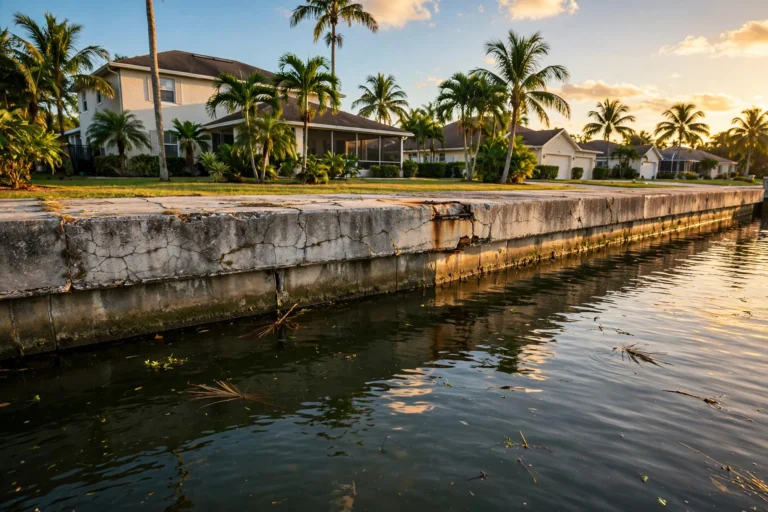
What you’re looking for are cracks wide enough to fit a finger into. If a crack is that wide, a licensed marine contractor should be called to inspect the seawall’s integrity. Vertical cracks typically indicate foundation settlement. Horizontal cracks are more serious and usually mean water pressure is building up behind the wall and forcing the concrete apart from the inside.
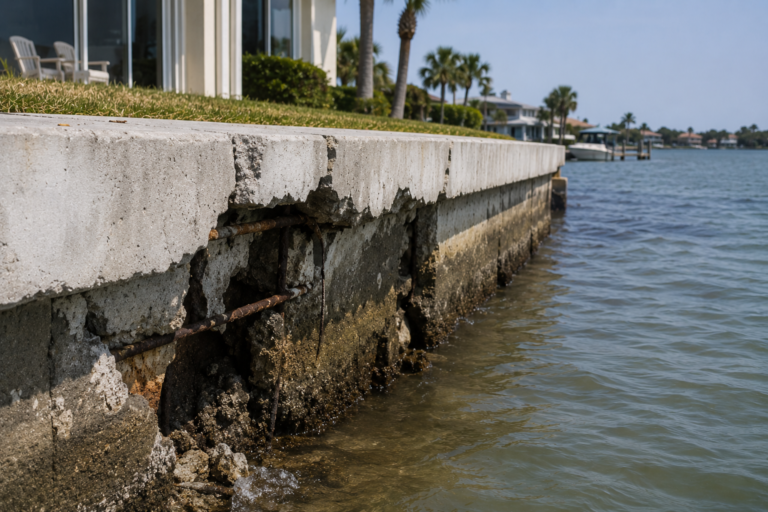
The cap deserves specific attention. The concrete beam running along the top of the wall ties the whole structure together. Cracks, spalling, or sections that have shifted signal the structure is losing its integrity, and a failing cap often means the panels below are already compromised. Longitudinal cracks along the cap are frequently caused by the steel rebar inside corroding and expanding, which cracks the surrounding concrete and accelerates the whole deterioration process.
Soil Loss, Sinkholes, and Soft Spots Behind the Wall
This is the warning sign that catches Pinellas homeowners most off guard, and the most urgent when it appears.
As tides move in and out each day, water pushes against seawalls and then recedes, pulling soil and sediment through cracks, joints, or gaps beneath the wall. Over time this back-and-forth creates voids behind the seawall, weakens the soil that supports it, and increases pressure on the structure. In plain terms: your yard is hollowing out underneath, and you can’t see it until the surface gives way.
Depressions forming near the waterline, soil that feels soft or spongy when you walk on it, or small sinkholes appearing behind the wall are all signs this process is already well underway. Many Tampa Bay area homeowners notice small holes near their seawall and try to fill them with gravel, but these potholes are often the first sign of soil erosion requiring professional repair. Filling a pothole without addressing the underlying erosion is putting a bandage over a structural crack. The erosion continues beneath the fix. Clogged weep holes are often the hidden cause behind this kind of soil loss.
To understand exactly how soil loss behind your seawall develops — and how contractors fix it without a full rebuild — read our 2026 guide.
Leaning, Bowing, or Tilting
Stand at one end of your seawall and sight down its length. It should be perfectly straight. Any lean, bow, or curve that wasn’t there before is a structural problem worth taking seriously.
A wall leaning from the top is most likely due to insufficient drainage behind the seawall. A lean from the bottom typically means loss of the wall’s front berm below the waterline. Both are serious, both get worse without intervention, and both are frequently repairable without full replacement when caught early. That window closes fast once the lean becomes pronounced.
After Helene and Milton, contractors across Pinellas County are reporting seawalls that showed slight leans before the storms now exhibiting dramatic movement. The surge accelerated years of gradual deterioration into months.
Often the hidden cause behind a developing lean is not drainage at all, but the anchor hardware itself: failed seawall tiebacks and anchors are one of the most common reasons older Pinellas County walls start moving. The steel tie rods and deadman anchors buried behind your wall corrode silently in salt-saturated soil, and once they let go there is nothing holding the top of the wall back. If your wall shows a lean along with rust staining, the anchoring system should be the first thing a contractor checks.
Water Seeping Through Joints or Panels
Tiebacks are the internal rebar structures that hold seawalls stable. When water reaches them it causes corrosion, which weakens the entire structure and eventually forces its way to the surface as visible damage. The seams between panels are the natural entry point for this process. Once a seam opens even slightly, every tide cycle pulls soil through it. Seam repair is one of the most cost-effective fixes available, but only when caught before the soil loss behind it becomes significant.
If you’re seeing water actively seeping through the wall face, through joints, or bubbling up from the ground near the wall base during high tide, that seepage has been going on longer than you realize.
Rust Stains on the Wall Surface
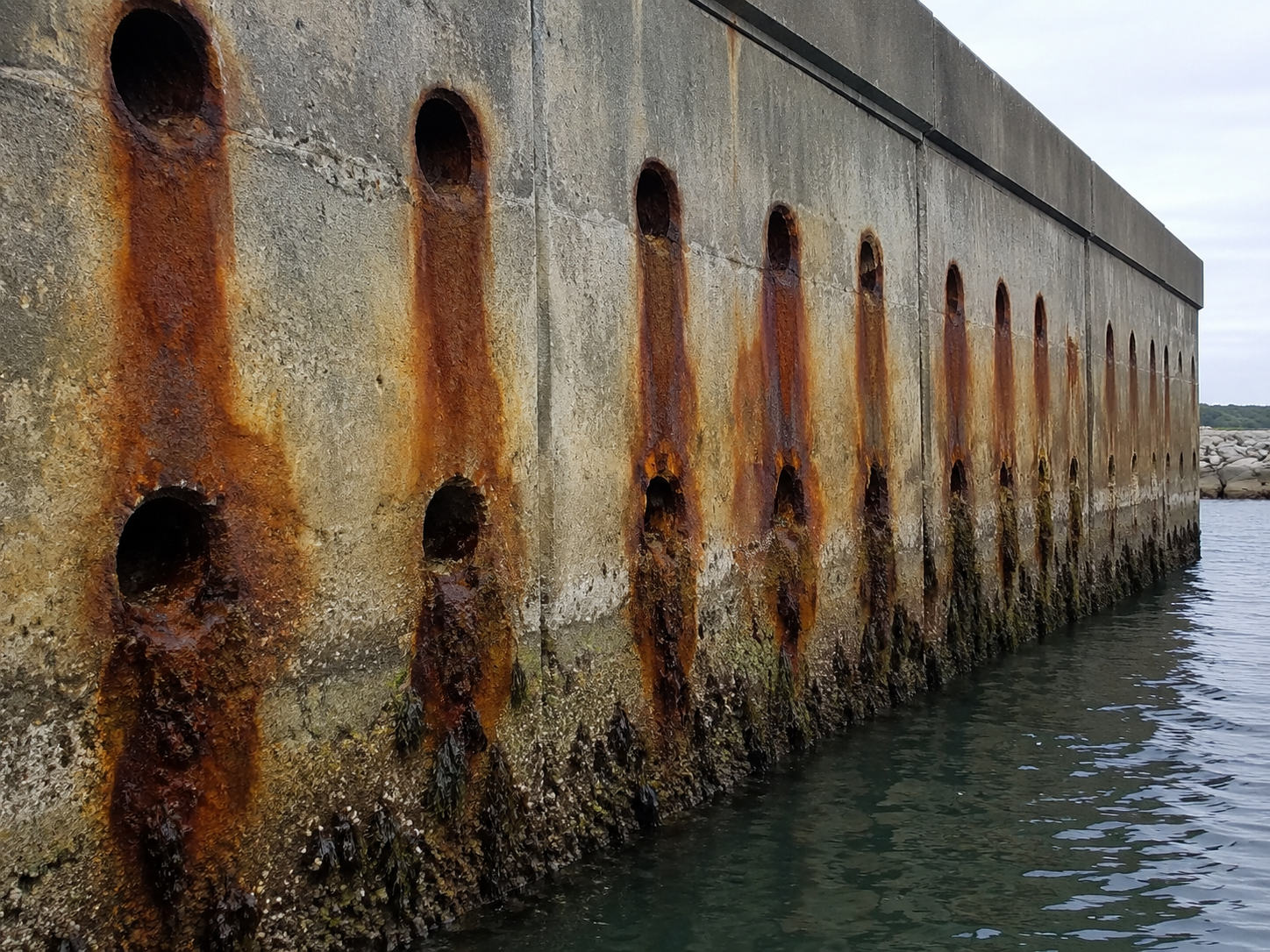
Brown or orange staining running down your seawall isn’t cosmetic. It means the steel reinforcement inside the concrete is corroding. Salt water penetrates small cracks, reaches the steel, and starts the corrosion cycle. As steel corrodes it expands, which widens the surrounding cracks, allows more water in, and accelerates the process. On an older Pinellas seawall some surface staining is expected. On a wall under 20 years old, visible rust staining is a red flag worth investigating quickly.
Clogged or Failing Weep Holes
This is almost never on a homeowner’s radar until a contractor points it out, and it’s responsible for more Pinellas County seawall failures than most people realize.
Weep holes are small drainage openings drilled through the seawall, typically positioned 6 to 12 inches above the average waterline. They act as pressure relief valves, allowing groundwater and rainwater to escape from behind the wall. When they work properly they prevent the hydrostatic pressure buildup that cracks and bows walls over time. When they get clogged with sediment, sand, roots, or marine growth, that pressure has nowhere to go.
Weep holes can be blocked by sand, soil, debris brought in by tides, loose mortar, and plant growth. Standing water that consistently pools behind your wall long after the tide has receded is often the first visible sign that drainage has failed. The maintenance fix is simple: clear weep holes at least twice a year with a plumber’s snake or stiff wire and flush with a garden hose. The structural consequence of not doing it can be severe.
A Note About Post-Storm Inspections
If you haven’t had your seawall professionally inspected since Helene and Milton, do it now. The surge levels recorded across Treasure Island, Madeira Beach, Indian Rocks Beach, and St. Pete Beach during those storms put forces on seawalls far beyond normal tidal stress. Walls that appeared fine last year may have sustained damage that isn’t visible from the surface. Voids behind the wall, compromised tiebacks, and panel movement that hasn’t yet translated into visible cracking are all things that only a professional inspection will catch.
Pinellas County itself has closed sections of public seawall due to storm damage, and the residential picture across the barrier islands is still being fully assessed. Contractors across the county are consistently finding post-storm damage that homeowners had no idea existed.
What To Do About A Failing Seawall
Knowing the signs of a failing seawall in Pinellas County can save you tens of thousands of dollars. Walk your seawall. Do it at low tide when you can see the most. Bring your phone and take photos. Look for everything on this list and note anything that looks different from the last time you paid attention.
If you see cracks wider than a quarter inch, active soil loss, any lean or bow, seepage through the wall, or rust staining on a wall under 20 years old, call a licensed contractor. Most reputable Pinellas County seawall specialists offer free evaluations. You’re not committing to anything by having someone look at it. You’re getting information.
What you’re trying to avoid is the scenario contractors here describe constantly: a homeowner who noticed something odd two years ago, decided to keep an eye on it, and is now looking at a full replacement instead of a targeted repair. If a full replacement is where you’re headed, start by comparing vinyl and concrete seawalls for Pinellas County homes. The wall communicates. It’s worth listening.
For the structural filter and the 50 percent rule contractors use, read our guide to the repair or replace decision. And once you know what your wall needs, read our guide to choosing a seawall contractor before you hire anyone.
Get a Free Assessment
If you’re seeing any of these warning signs on your Pinellas County property, SeawallAdvice.com can connect you with a vetted local seawall contractor for a free evaluation. Fill out the form below or call or text us at (727) 316-5675. We’ll connect you with someone who knows Pinellas County waterways within 24 hours.
FAQ
Q: What are the first signs a seawall is failing?
A: The earliest signs are usually small soil depressions or soft spots forming behind the wall, hairline cracks widening in the cap, and water seeping through panel joints. Most homeowners first notice potholes or small sinkholes forming near the waterline, which indicate soil is already eroding beneath the surface.
Q: How do I know if my seawall needs repair or replacement?
A: Repair makes sense when damage is limited to specific cracks, cap deterioration, or isolated panel issues and the wall is structurally sound and under 25 years old. Replacement is typically necessary when panels are bowing significantly, widespread soil loss has occurred, or the wall is over 30 years old with multiple failure points. A professional inspection is the only reliable way to make this determination accurately.
Q: How often should I inspect my seawall in Florida?
A: At minimum once a year, and after every significant storm. Pinellas County’s tidal conditions and hurricane exposure mean problems can develop quickly. Walk the wall yourself regularly at low tide and have a licensed contractor do a professional inspection every few years, or immediately after any storm event that produced significant surge.
Q: Can a leaning seawall be repaired without full replacement?
A: In many cases yes, particularly when the lean is caught early and the underlying cause hasn’t progressed too far. Modern repair methods including soil stabilization, void filling, and tieback reinforcement can restore a leaning wall without full replacement. The earlier it’s addressed, the more options you have.
Related reading: How long do seawalls last in Pinellas County?