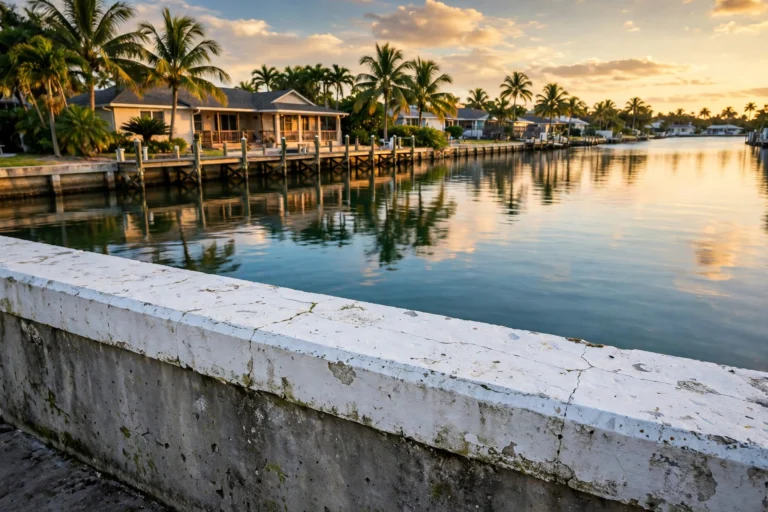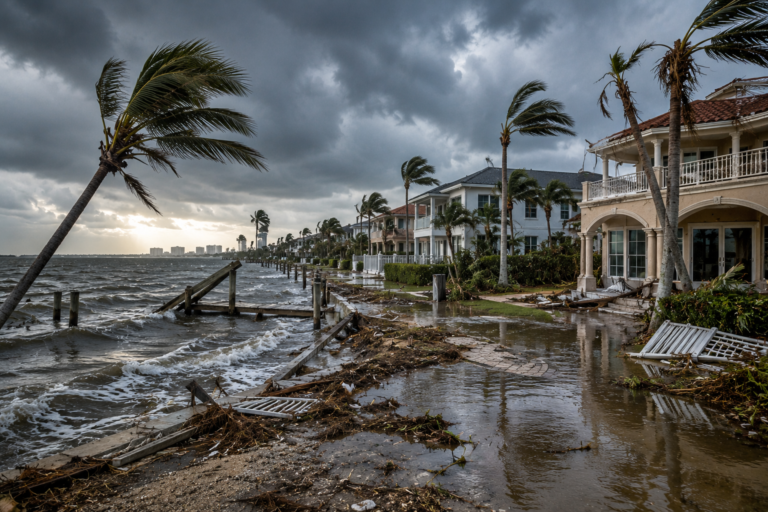
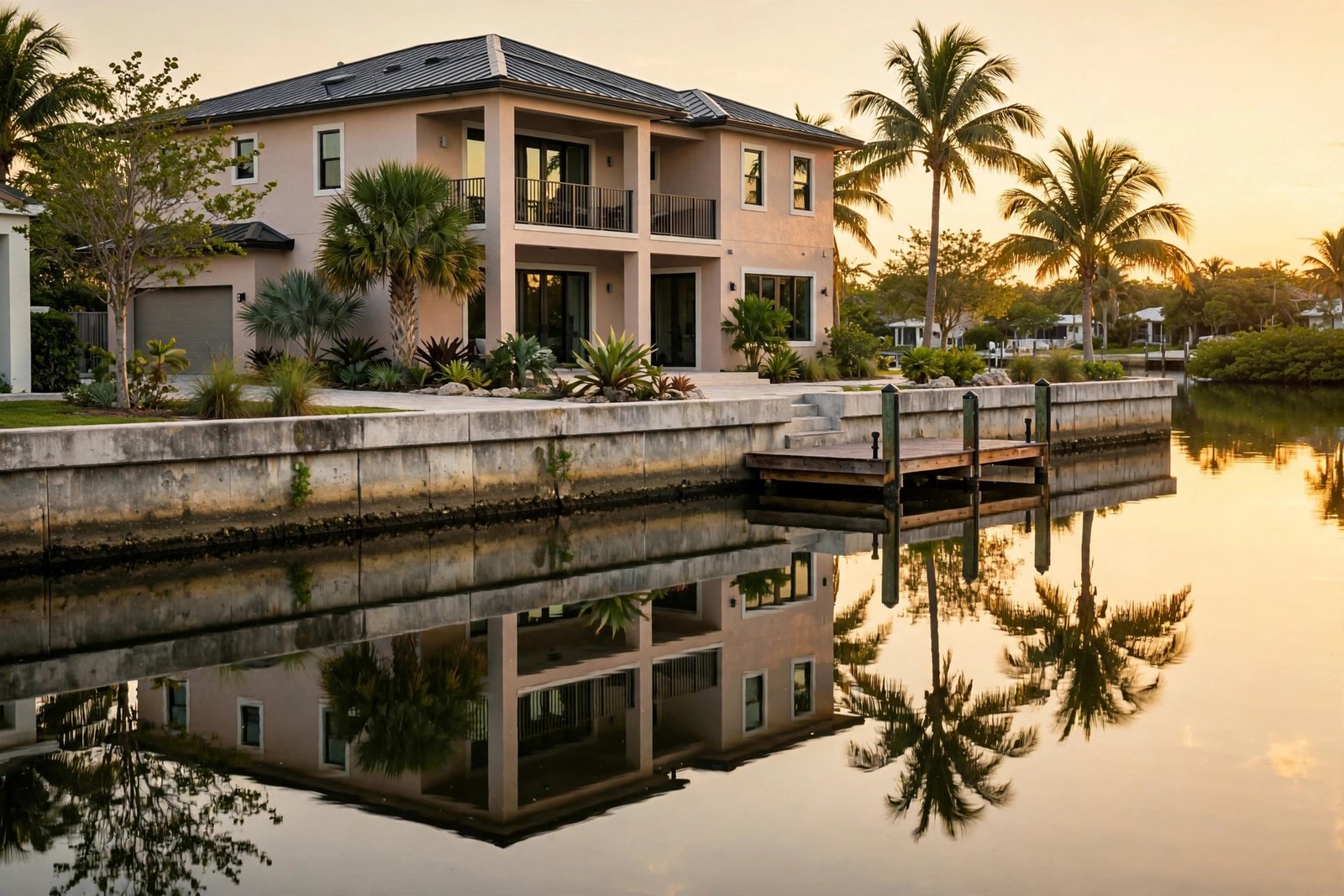
Seawall Tiebacks and Anchors: The Hidden Hardware Holding Your Pinellas County Seawall Upright (2026 Guide)
Stand on your dock and look at your seawall. What you see is a flat wall of concrete or vinyl holding back your yard. What you do not see is the reason it has not toppled into the canal yet. Buried in the soil behind that wall is a row of steel rods and anchors, collectively called the tieback system, and they are doing the hardest job on your entire property.
Most waterfront homeowners in Pinellas County have never heard of seawall tiebacks until a contractor points at a lean they never noticed. That is a shame, because the anchoring system usually decides whether your wall has another twenty years in it or is quietly heading for failure. Here is what holds your wall upright, how it fails in our salt-saturated soil, the warning signs, and what fixing it costs in 2026.
How Seawall Tiebacks and Anchors Actually Work
A seawall is not freestanding. Every foot of wall fights the constant push of saturated soil and groundwater behind it, trying to shove it into the canal. The anchoring system is what lets it stand.
The Tie Rod, the Waler, and the Deadman
On most concrete seawalls built in Pinellas County over the last several decades, the system has three parts. The tie rod is a steel rod that runs horizontally from the top of the wall back into your yard. One end bolts through the cap or a horizontal waler beam at the top of the wall. The other end connects to a deadman anchor, a buried mass of concrete or a steel plate in undisturbed soil.
The physics are simple. Soil pressure pushes the wall waterward. The tie rods transfer that load back into the deadman, buried in soil that has no reason to move. The waler spreads the load across multiple rods so no single anchor carries the whole wall. When all three parts are sound, the wall stays put for decades.
Helical Anchors and Modern Systems
Newer walls and many repair jobs use helical anchors, sometimes called screw anchors: steel shafts with helical plates that a crew twists deep into the ground behind the wall. They need no poured deadman and disturb much less of your yard, which is why contractors favor them for retrofit work. They are still steel, so corrosion remains their eventual enemy.
Vinyl and composite walls use variations of the same idea. The materials differ, but the principle never changes: something has to hold the top of the wall back, and it is always out of sight.
Why Tiebacks Fail in Pinellas County
Tiebacks rarely fail because they were installed wrong. They fail because of where they sit.
Saltwater Corrosion Eats Steel Faster Than You Think
The tie rods behind your wall sit in soil that soaks up saltwater with every tide, storm surge, and fall king tide season. Steel anchor rods in saltwater-saturated soil typically last 20 to 30 years before corrosion compromises them, according to industry guidance that mirrors what local contractors see. That number matters enormously here, because so much of the residential seawall inventory along the Pinellas coast and inland canals went in during the building booms of the 1960s through the 1980s. A wall built in 1975 is now over fifty years old, and its tiebacks have been living on borrowed time for decades.
Water Pressure Does the Heavy Work
Corrosion is the slow killer. Water pressure is the constant one. Every heavy rain loads the soil behind the wall with water, and that water has to go somewhere. On a wall with working drainage, weep holes and filter fabric let it seep out without taking soil with it. On a wall with clogged or missing weeps, the water sits, pressure builds, and the soil pushes harder against the wall and the anchor system alike.
This is the part of the story we covered in our guide to seawall weep holes, and it deserves repeating here because drainage and anchors are two halves of the same battle. A tieback system in good soil can hold a lot. The same system fighting waterlogged soil is being asked to hold much more than it was designed for.
The Cap Connection Weakens
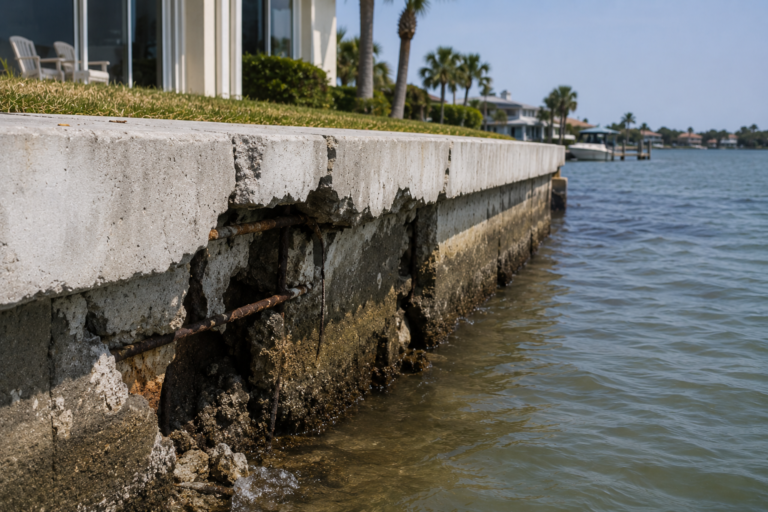
Tie rods connect to the wall at the top, through the cap or the waler. When the cap cracks, spalls, or deteriorates, the rods lose their anchor point. Industry field manuals note the relationship plainly: as the cap comes apart, tieback rods have no solid structure to hold onto, and without a solid cap there is nothing keeping the wall panels in alignment. If you have been tracking seawall cap repair on your own wall, understand that cap problems are also anchor problems. The two are physically bolted together.
The Warning Signs Your Anchors Are Failing
You cannot see your tiebacks, but you can read what the wall tells you.
The Lean
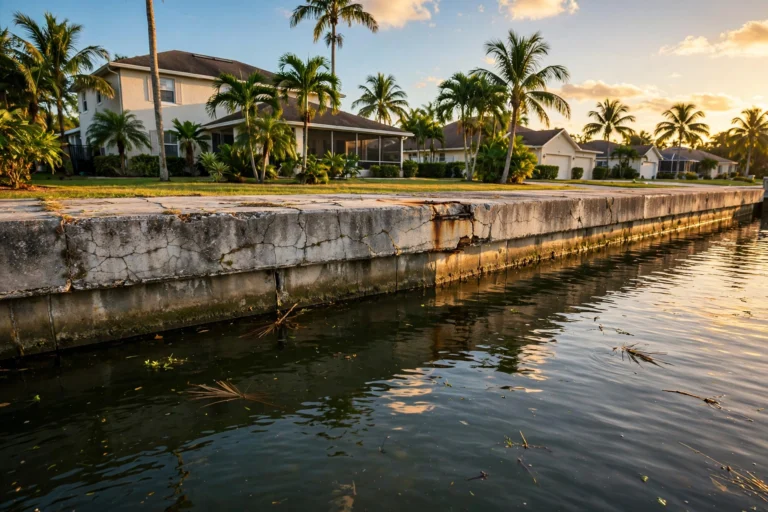
A wall leaning toward the water is the signature symptom of failed tiebacks: the anchors are no longer holding the top of the wall back. Stand at one end and sight down its length, or stretch a string line along the cap. A lean of even an inch or two is worth a professional look, and a lean you can see without trying has been developing for a while.
Rust Stains Weeping Down the Wall Face
Rust staining on the face of the wall, especially around joints or near the top, is usually an early sign that embedded steel is corroding from the inside out. Tie rods rust first where they pass through the wall. A wall with rust tears is telling you what is happening to its steel.
Soil Loss and Soft Spots Behind the Cap
When anchors fail and panels shift, joints open and soil starts washing through. Depressions in the yard, soft or spongy ground near the wall, pavers pulling away from the edge, and gaps forming behind the cap all point to soil leaving. These are among the signs your seawall is failing more broadly, but when they appear alongside a lean, the anchors are the prime suspect.
Can Failed Tiebacks Be Repaired, or Is It Replacement Time?
Installing New Tiebacks and Secondary Anchors
When the wall panels are still plumb and intact but the original anchors have corroded out, contractors can install a new anchoring system without rebuilding the wall. That usually means driving helical tie-back anchors deep into stable soil behind the wall and connecting them to the existing structure, sometimes with a new waler or reinforced cap for a solid attachment point. It is a legitimate, long-lived repair when the wall itself is still good.
It is structural work, so it is priced accordingly. As of 2026, national cost data puts new caps with tiebacks at roughly $125 to $230 per linear foot, secondary anchors at roughly $225 to $300 per foot, and fixing an already-leaning wall at roughly $200 to $600 per foot. On a typical 100-foot canal lot, a tieback retrofit lands in the low five figures, against replacement that generally runs toward six figures on the same lot.
When Repair Stops Being Honest
New anchors cannot save a wall that is done. If the panels are cracked through, shifted out of alignment, or breaking along the waterline, there is no structure left worth anchoring to. If the toe has scoured out and the bottom is kicking forward, anchors at the top will not fix a foundation problem at the bottom. And if the wall is leaning along a long run, the anchors have failed as a system, not as one bad rod.
Age matters too. New anchors on a 50-year-old wall can buy a decade or more, but they cannot make the concrete young again. A five-figure repair that buys ten years is often the right call. The same repair on a wall with five years of life left is just expensive procrastination.
What to Ask a Contractor About Your Anchors
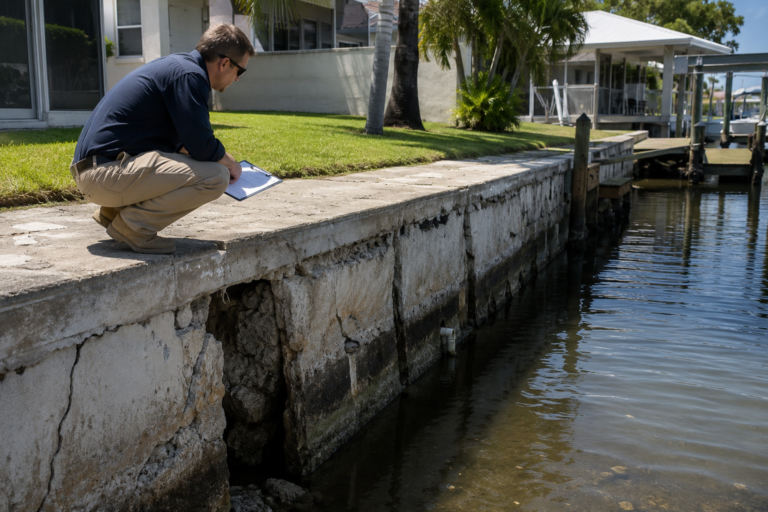
Anchors are invisible, which makes them a great place for hand-waving. Compare answers across at least two contractors. Ask what type of anchor system the wall has and how they know: they should point to the rust, the lean, or the load evidence, not just the age. Ask what the new anchors will connect to, since they need a solid attachment point; a quote that never mentions the cap is incomplete. Ask what steel they use and what corrosion protection it has. Ask what happens to the failed originals: they stay in the ground but should be documented and disconnected. Finally, ask for the expected service life of the repair in writing. Ten years? Fifteen? That number is what you are actually buying.
The Pinellas County Reality Check
First, the age of the housing stock. Clearwater, Largo, Seminole, the beach communities, and the inland canal neighborhoods all carry seawalls from the same mid-century building waves, and their original tieback systems are aging out at the same time. If your neighbors are getting anchor work done, it is not a coincidence.
Second, the water. Fall king tides push saltwater a foot or more above normal against back-bay walls for weeks at a time, exactly the salt soak that accelerates tie rod corrosion. Hurricane season runs June through November, and surge from storms like Helene pushed saltwater deeper into yards than older drainage systems were built to handle.
Third, permits. Anchor work is structural repair, and Pinellas County reviews structural seawall work seriously. We covered the local reality in our guide to the seawall permit process in Pinellas County. Start early, because a leaning wall does not improve while it waits.
Talk to a Local Seawall Expert
Your seawall’s anchors do invisible work every day, and by the time they show you symptoms, they have been struggling for a while. If your wall has a lean, rust stains, or soft spots behind the cap, get someone who looks at these systems every day to walk it. Call (727) 316-5675 for a straight answer on what is actually holding your wall up.
Q: What are seawall tiebacks and how do I know if my seawall has them?
A: Seawall tiebacks are steel rods or anchors that run from the top of your seawall back into your yard, connecting the wall to buried deadman anchors that hold it upright against soil pressure. Nearly every concrete seawall in Pinellas County has some form of them. You cannot see them directly, but a contractor can confirm the system type during an inspection.
Q: How long do seawall anchors last in Pinellas County?
A: Steel tieback rods in saltwater-saturated soil typically last 20 to 30 years before corrosion compromises them. Many Pinellas County seawalls were built in the 1960s through the 1980s, so their original anchors are now well past that window. Galvanized or coated hardware lasts longer, but no steel anchor is permanent in our soil.
Q: Can a leaning seawall be fixed without replacing the whole wall?
A: Yes, if the wall panels themselves are still sound. Contractors can install new helical anchors deep into stable soil and connect them to the existing wall, often with a rebuilt cap as the attachment point. As of 2026, secondary anchors run roughly $225 to $300 per linear foot nationally, and fixing a leaning wall runs roughly $200 to $600 per foot. If the panels are cracked through or the lean runs a long stretch, replacement is the more honest call.
Q: What are the early warning signs that my seawall anchors are failing?
A: Watch for a lean developing toward the water, rust stains weeping down the wall face, soft or spongy ground behind the cap, and cap cracks that keep reopening after repair. Sight down the length of your wall occasionally, since a slow lean is easy to miss. Any of these signs is worth a professional inspection before the failure cascades.