How to Choose a Seawall Contractor in Pinellas County: 9 Questions to Ask Before You Sign
Your seawall is the most expensive thing on your property that you never think about. Until it starts leaning or your yard starts sliding toward the canal. Then hiring the right seawall contractor becomes the most important decision you will make as a waterfront homeowner in Pinellas County. A good crew can build a wall that outlives you. A bad one can turn a $20,000 repair into a $60,000 do-over, and you will not know until the first king tide of fall tests their work.
There are no national chains, no big franchises, no showrooms in this trade. Most seawall work here is done by small local marine contractors, and the gap between the best and the worst is enormous. Here is how to tell them apart before money changes hands.
Start With the License, Not the Sales Pitch
In Florida, seawall construction is regulated work. Anyone who builds or rebuilds a seawall needs proper licensing through the Florida Department of Business and Professional Regulation, and many Pinellas County municipalities also require local competency or registration. The first thing you ask any contractor is for their license number, and the second thing you do is verify it yourself at MyFloridaLicense.com. Do not skip that second part. A license number on a truck door is a claim, not proof.
You are looking for a license that is active, in good standing, and appropriate for marine construction. A state certified general contractor or a marine specialty license is what you want to see for seawall work. Be wary of anyone who says they can do the job under somebody else’s license, or who proposes to pull the permit in your name as the owner-builder while they act as your “helper.” Both are classic ways for unlicensed operators to run jobs that look legitimate. If the contractor cannot legally pull the permit himself, he is not a seawall contractor. He is a day laborer with a boat.
Licensing matters more here than in almost any other trade because a seawall failure is structural. If the wall gives way, your yard, your dock, and sometimes your pool deck go with it. A licensed marine contractor carries general liability insurance and workers compensation. Ask for certificates of insurance with your address and the project named on them, and call the insurer to confirm they are current. Ten minutes of checking protects you from the nightmare of an injured worker or a collapsed wall with nobody to pay for it.
Ask Who Actually Does the Work
Many seawall companies are sales and permitting offices that subcontract construction to independent crews. That is not automatically a problem, but you deserve to know the arrangement before you sign. Ask point blank: will your own employees build my wall, or will you subcontract it? Who supervises the crew on site every day? Then ask for references from recent jobs and actually call them. A good contractor hands you names without flinching. A bad one stalls or gives you numbers that never ring.
Also ask how much of their business is seawalls versus docks or general construction. A contractor who builds forty seawalls a year knows our soil, our canals, and our permitting offices in a way a builder who does one seawall job annually never will. Pinellas County waterfront has quirks only repetition teaches: soft muck layers in the intracoastal, older walls with no tiebacks at all, and cities like St. Pete Beach and Treasure Island that enforce their own marine construction rules on top of county and state permits.
The Questions That Separate Pros From Pretenders
Once the license checks out, the estimate meeting is your interview. Any contractor worth hiring should welcome these questions, because they get asked them by every informed homeowner. Treat hesitation or irritation as information.
What material do you recommend for my property, and why?
The honest answer depends on your site. Vinyl sheet piling dominates new residential seawalls in Pinellas County for good reasons: it never rusts, it handles our saltwater well, and it typically runs less than concrete for residential jobs. But there are situations where concrete makes more sense, or where an existing wall is a candidate for repair rather than full replacement. Be suspicious of any contractor who recommends the same material for every job. That usually means he installs one system and sells it regardless of fit. If you are still weighing options, it helps to know the real tradeoffs between vinyl and concrete before the sales pitch starts.
How do you handle the anchoring system?
This question alone filters out a surprising number of contractors. A seawall is only as good as the tieback system holding it back, and a contractor who waves this off or cannot explain deadman anchors, helical anchors, and walers in plain language is not someone you want building your wall. Ask what type of anchor system they plan to use on your job, how deep it goes, and what protects it from corrosion. The answers should be specific to your soil conditions, not generic.
Will you pull the permits yourself?
The right answer is always yes. Seawall permits in Pinellas County can involve the county, your municipality, the state Department of Environmental Protection, and sometimes the Army Corps of Engineers. A real marine contractor knows this process cold and includes permit handling in the job. If a contractor suggests you pull the permits to save money, walk away. The permit office checks licensing on every application, which is exactly why unlicensed operators push owner-builder permits. Our walkthrough of the seawall permit process in Pinellas County explains what should be happening behind the scenes on your behalf.
What is your warranty, and what does it cover?
Material warranties come from manufacturers. Workmanship warranties are where contractors differ. Get it in writing: how many years, what it covers, what voids it, and who pays if the wall settles or a cap cracks. One year is the floor. Five to ten years is a sign of a company that stands behind its crews. And ask how warranty claims are handled in practice, because a warranty is only as good as the company that answers the phone in year six.
Can I see a job you finished at least two years ago?
New walls all look great. A two year old wall tells you about settling, cap cracking, and drainage. Any established contractor has older work and homeowners willing to talk. Look for the details: straight cap lines, clean tie-in points where new meets old, and weep holes that are actually draining.
What does the estimate include, and how do you handle change orders?
Line items matter. An estimate should spell out linear footage, material type and thickness, the anchor system, cap construction, demolition and disposal, backfill and compaction, restoration, permits, and cleanup. Vague lump sums make bids impossible to compare and leave room for change orders later. Ask how extras are priced and documented, and whether any work proceeds before you sign off in writing. Change orders are where cheap bids get expensive.
What is the realistic timeline?
Seawall contractors in Pinellas County have been running months behind since the 2024 hurricanes, and any honest estimate reflects that. A contractor who promises to start next week when everyone else is quoting a three month wait is either about to disappoint you or about to do a rushed job. Ask for a realistic start date and a realistic duration, and get both in writing. Also ask how weather delays are handled, because afternoon storms are a fact of life in our summers.
Who do I call if something goes wrong?
Get a name and a direct number, not a general office line. Seawall projects have moments when you need answers fast: a neighbor complains about vibration, a dock post shifts, a rainstorm exposes a drainage problem. The quality of a contractor’s communication during the job predicts the quality of the work itself. If getting a straight answer before the sale is hard, imagine what it will be like after you have paid the deposit.
Watch How They Handle Permits
A legitimate contractor treats permitting as part of the job, not an add on. He knows which agencies have jurisdiction over your canal or bay frontage and can tell you upfront what your job needs and how long it takes. That is also a useful reality check on the timeline he quoted: permits alone can take weeks to months here, so a start date of next Monday with no mention of permits is a red flag. Our guide to the seawall permit process in Pinellas County explains what should be happening behind the scenes on your behalf.
Get Three Estimates and Compare the Right Things
Every homeowner guide says to get three bids. Few explain how to compare them, because seawall bids often do not describe the same work.
Do not just line up the totals and pick the middle one. Two vinyl walls can differ enormously in sheet thickness, cap design, and anchor hardware. Compare what is excluded too: demolition, backfill, sod, engineering, permits. A bid that leaves out half the scope will grow. And compare the payment schedule. Deposits of 30 to 50 percent are normal because materials are ordered upfront, but never pay the full balance before the work is complete and inspected.
As of 2026, straightforward residential seawall replacement in Pinellas County often runs several hundred dollars per linear foot, with repair work typically less. Our breakdown of seawall repair costs in Pinellas County gives you a realistic baseline so you can spot a bid that is suspiciously cheap or absurdly high. A bid that undercuts everyone by 40 percent is not saving you money. It is cutting a corner you will pay for later, usually in the part of the wall you cannot see.
Red Flags That Should Send You Running
Some warning signs are absolute. Walk away if a contractor cannot produce a verifiable license, will not provide insurance certificates, asks for cash or full payment upfront, or pressures you to sign today for a special price. Those are not negotiating tactics. They are the calling cards of operators who will not be around when the wall fails.
Other flags are subtler. A contractor with no written contract, no local references, or a brand new business name with no track record is a gamble you do not need. Be cautious of storm chasers who arrived after the last hurricane and will leave before the next one. And if a contractor dismisses your questions about anchors, drainage, or permits as unnecessary worry, he is telling you exactly how much attention he pays to the details that keep your wall standing. Believe him.
What a Fair Deal Looks Like in Pinellas County Right Now
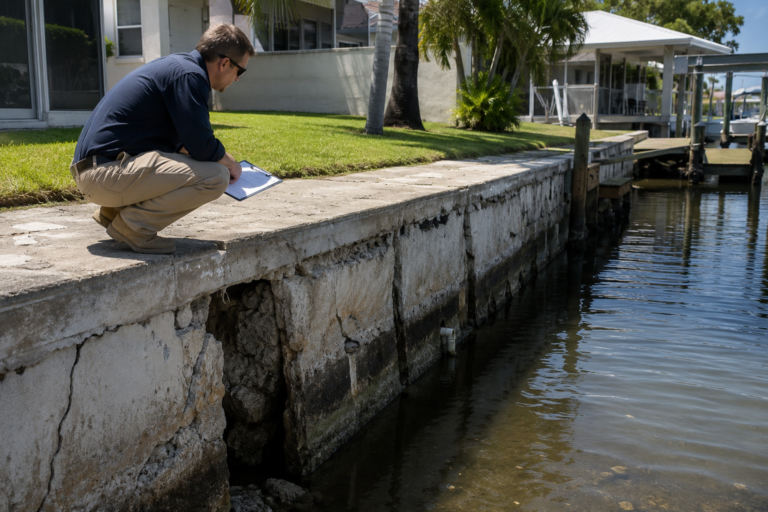
A good seawall project follows a predictable shape. It starts with a site visit where the contractor walks the wall and asks about drainage and soil loss. It continues with a written estimate that names the material, the anchor system, the footage, and the full scope including permits and restoration. The contract spells out the payment schedule, the warranty, the timeline, and the change order process. The crew shows up when promised, builds what was specified, cleans up, and leaves you with documentation: permits, drawings, warranty paperwork, and a contact who answers the phone.
If you are not sure whether you need a full replacement or just a repair, that decision shapes everything else. A contractor who only builds new walls has a financial incentive to tell you every wall needs replacing. Our guide to seawall repair versus replacement walks through how to tell which camp your wall is in before you start collecting bids.
Take your time, ask the hard questions, verify the license yourself, and hire the contractor who answers plainly and writes everything down. Your yard, your dock, and the next king tide will thank you.
Talk to a Local Seawall Expert
If you are starting to collect bids and want a second set of eyes on your wall before you sign anything, call (727) 316-5675. We will walk you through what your contractor proposed, what the estimate should include, and whether the price is fair for Pinellas County. No pressure, no sales pitch, just straight answers from people who know these walls.
Q: How much does it cost to hire a seawall contractor in Pinellas County?
A: As of 2026, residential seawall replacement in Pinellas County typically runs several hundred dollars per linear foot depending on material, height, and access. Repair work costs less. Always get three written estimates with full line items, and compare what each bid includes rather than just the total, since excluded items like demolition, backfill, and permits are where cheap bids hide their real cost.
Q: What license should a seawall contractor in Florida have?
A: Seawall construction in Florida requires proper licensing through the Florida Department of Business and Professional Regulation, plus local competency or registration in many Pinellas County municipalities. Ask for the license number and verify it yourself at MyFloridaLicense.com. A contractor who cannot legally pull the permit himself is not a seawall contractor, and anyone proposing an owner-builder permit arrangement is a red flag.
Q: Should I repair or replace my seawall before hiring a contractor?
A: It depends on the wall’s condition. Walls with minor cap damage, small cracks, or isolated soil loss are often good repair candidates, while walls with structural cracking, significant lean, or widespread anchor failure usually need replacement. Be aware that a contractor who only builds new walls has an incentive to recommend replacement, so consider getting an independent opinion before you start collecting bids.
Q: How long does a seawall project take in Pinellas County?
A: The construction itself often takes one to three weeks for a typical residential wall, but permits and contractor backlog extend the real timeline. As of 2026, many Pinellas County marine contractors are still booking months out after the 2024 hurricanes, and permits alone can take weeks to months. Any contractor who promises to start next week without mentioning permits is not being honest with you.