How Long Do Seawalls Last in Pinellas County? (2026 Guide)
Every waterfront homeowner in Pinellas County eventually asks the same question. Sometimes it comes up the day they buy the house, when the home inspector shrugs at the seawall and says it looks fine. Sometimes it comes up years later, when a hairline crack appears and they start doing math. How many more years does this wall have? Seawall lifespan in Florida comes down to three things: the material, how well it was installed, and how the last few decades of saltwater, storms, and king tides have treated it. Here is what each material typically gives you, what cuts that number short on the Pinellas coast, and how to tell when your wall is running out of time.
The Short Answer: Seawall Lifespan by Material
Here is what local contractors generally expect from a well-built residential seawall in Florida conditions. These are realistic service lives, not marketing numbers.
Vinyl Sheet Pile: 30 to 50 Years
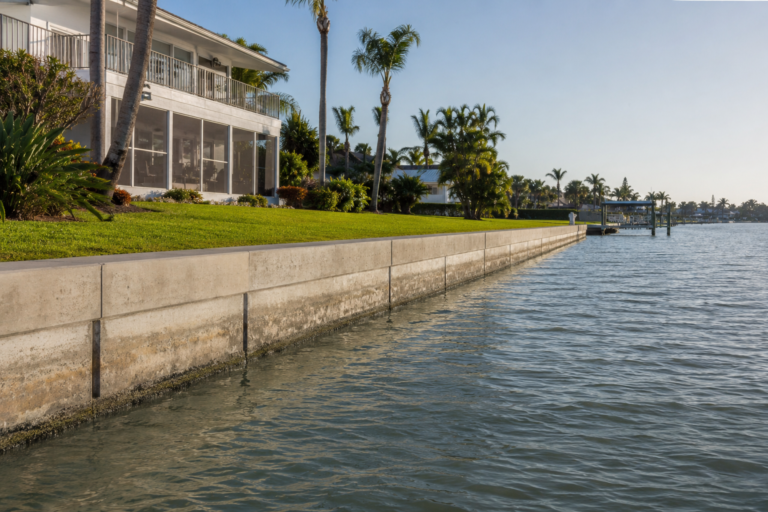
Vinyl is the most common material for new residential seawalls in Pinellas County, and lifespan is a big reason why. Vinyl does not rust, it does not feed marine borers, and it handles constant saltwater immersion without the corrosion cycles that kill other materials. Most local contractors put realistic service life at 30 to 50 years, and some manufacturers back their panels with 50-year warranties against rust, rot, corrosion, marine borers, and UV damage. When vinyl walls fail early, the cause is almost always something else: washed-out soil, failed tiebacks, or drainage that was never installed properly. If you are weighing materials for a replacement, our vinyl vs concrete seawall comparison for Pinellas County breaks down the tradeoffs in detail.
Concrete: 30 to 40 Years
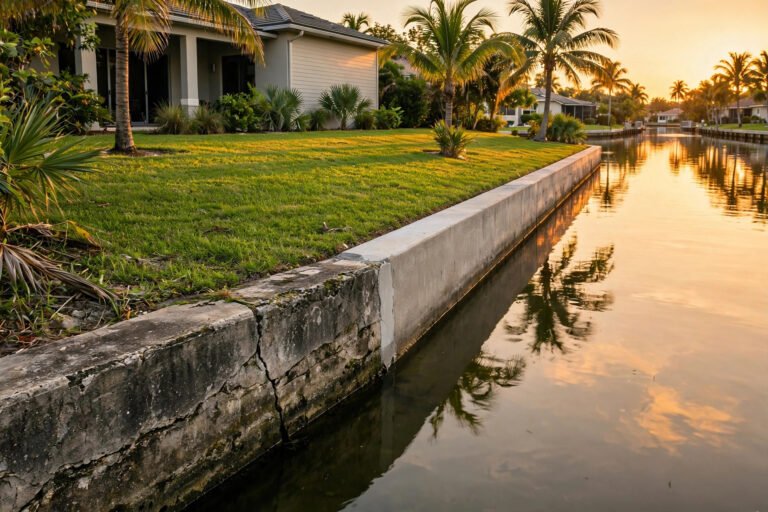
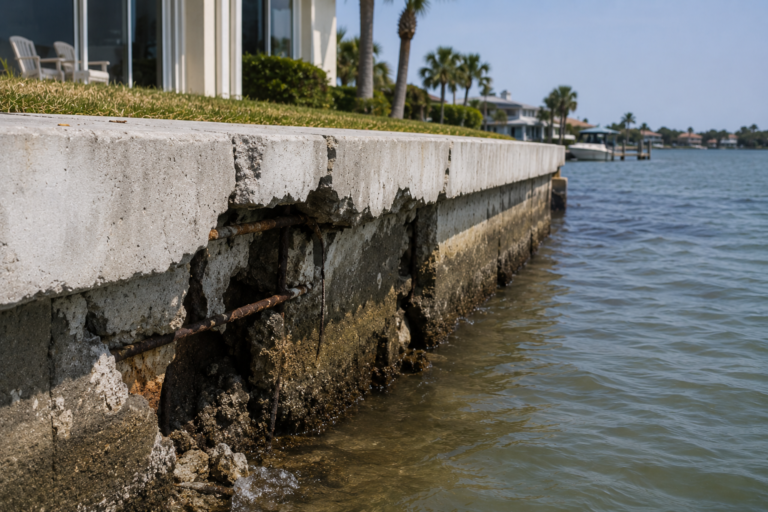
Concrete seawalls are the workhorses of the Pinellas shoreline. Many of the walls along Boca Ciega Bay, the canals of St. Pete Beach, and the older neighborhoods of Treasure Island and Indian Shores went up between the 1960s and the 1990s, and plenty are still standing. A well-built concrete wall typically gives you several decades of service. The catch is that concrete does not die all at once. It dies by slow saltwater attack. Seawater works its way through tiny cracks until it reaches the steel rebar inside, and then the rebar rusts. Rust expands, which cracks and spalls the concrete around it, which lets in more saltwater. Once this corrosion cycle is visibly underway, the clock is ticking even if the wall still looks mostly fine from your patio. Walls on open water age faster than walls in a sheltered canal.
Timber and Wood: 15 to 25 Years
Pressure-treated wood seawalls were common across Pinellas County for decades, and plenty are still out there, especially in Tarpon Springs, Oldsmar, and the older parts of Safety Harbor. In Florida marine conditions, wood typically lasts 15 to 25 years. Wood walls here face a double attack: rot from constant wet-dry cycling at the waterline, and marine borers, the small organisms that tunnel through submerged timber and can hollow out a piling in a few seasons. If your wall is wood and it went in before the mid-2000s, there is a good chance it is at or past its expected service life right now.
Steel: 25 to 35 Years
Steel seawalls are strong and they go up fast, which made them popular for commercial sites and some residential jobs. Their enemy is corrosion, especially at the splash zone where wet-dry cycling is most aggressive. Galvanized or coated steel does considerably better. Steel is less common on new residential jobs in Pinellas County than it used to be, largely because vinyl delivers comparable strength without the corrosion maintenance.
Why Installation Matters More Than the Material
Two identical vinyl seawalls, same panels, same manufacturer, can have wildly different lifespans. One lasts 45 years. The other starts leaning at year 12. The difference is almost always the installation. A seawall is a system of panels, tiebacks or deadman anchors buried in the yard, a cap tying the top together, and drainage letting water pass through instead of pushing against everything. If any part of that system was undersized or poorly built, the wall starts its life on borrowed time.
Embedment depth is the big one. Panels must be driven deep enough below the canal bottom to stay put under pressure, and on the sandy soils that make up most of Pinellas County that depth matters even more, because sand scours and shifts easily. Tiebacks matter just as much. These rods or cables run from the wall back into the yard, anchored to buried deadman blocks, and they are what keep the wall from tipping forward into the water. Older walls often have tiebacks that have corroded away entirely, and from the surface you would never know until the wall starts to lean. Drainage is the quiet killer. We have written before about how weep holes and drainage decide a seawall’s fate, and lifespan is where that story ends. A wall with working drainage only has to hold back soil. A wall with blocked drainage has to hold back soil plus a rising reservoir of trapped groundwater, tons of extra lateral force the structure was never designed for. Plenty of Pinellas walls that owners think died of old age actually died of clogged weep holes ten years before their material gave out.
What Shortens a Seawall’s Life on the Pinellas Coast
Even a well-built wall lives a hard life on this coastline, where saltwater, sun, and storms all hit at once.
King tides and storm surge do the most aging. Fall king tides push water levels feet above normal, repeatedly, year after year. Each cycle saturates the soil behind the wall and then drains it, a pumping action that gradually washes fine soil out through joints and weep holes. Hurricane surge is the extreme version. Hurricane Helene pushed record surge into Pinellas waterways in 2024, and many walls that had been quietly aging for decades crossed a tipping point in a single night.
Boat wakes are next. Walls along the Intracoastal Waterway and the busy channels near John’s Pass and Clearwater Pass take a constant beating. Wave energy reflects off the wall face and scours the soil at its base, slowly undermining the embedment the wall depends on. Canal walls in quiet backwaters age far more gracefully than walls facing open water, even when both were built the same year.
Then there is the sun. Vinyl’s weak point is not saltwater, it is ultraviolet light and heat on the exposed cap and upper panels. Over decades, Florida sun can make vinyl brittle above the waterline while the submerged sections stay sound. Keeping the cap in good shape is the cheapest life-extension a vinyl wall owner can buy. Finally, neglected maintenance: clearing weep holes, keeping the cap sealed, filling small voids before they grow, and getting a professional look after major storms. None of it is expensive. The walls around Pinellas County pushing 50 years almost always belong to owners who did the boring stuff on schedule.
Signs Your Seawall Is Nearing the End of Its Life
Materials have expected lifespans, but your specific wall has its own story. The difference between normal aging and end-of-life is whether the problems are cosmetic or structural. Surface staining, minor cap wear, and a little algae are cosmetic. Movement is structural, and movement is the line you do not cross without calling a contractor. Walk your wall at low tide and look for leaning or bowing sections, gaps opening between the cap and the panels, cracks widening year over year, and rust staining that is spreading rather than stable.
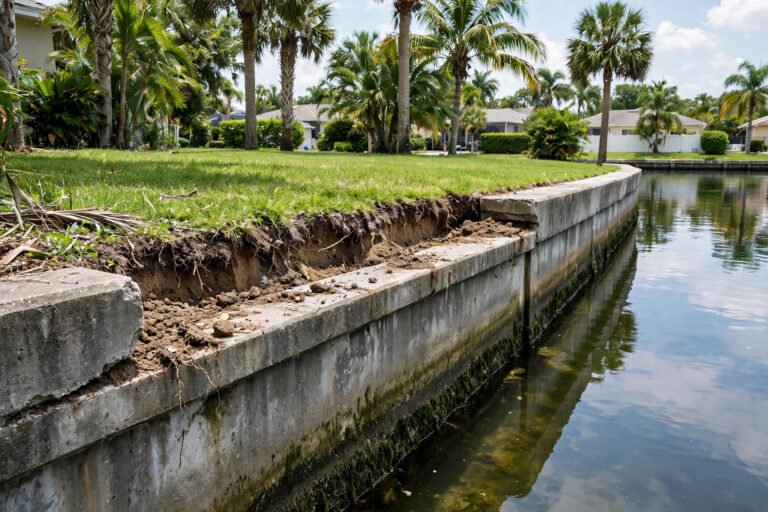
Then walk your yard. Sinkholes, settling pavers, or soil pulling away from the back of the cap mean the wall is losing its grip on the soil it is supposed to hold. If you are seeing several of these at once, read our full guide to the signs your seawall is failing and take it seriously. A wall showing structural symptoms will not stabilize on its own.
Repair or Replace? The End-of-Life Decision
When a wall is clearly aging out, homeowners face the big question: patch it or replace it? Isolated problems on an otherwise straight, stable wall are repair candidates. Cracked cap sections can be recapped. Localized soil loss can be filled with polyurethane foam injection. A section of failed tiebacks can sometimes be re-anchored. These repairs make sense when the wall has years of structural life left and you are fixing a component, not the whole system. Our 2026 guide to seawall repair costs in Pinellas County will help you judge whether the quotes you get are reasonable.
Replacement becomes the honest answer when the problems are systemic. If the wall is leaning along most of its length, if concrete is spalling in multiple sections, if tiebacks have corroded out across the whole run, or if you are repairing the same wall every couple of years, you are spending replacement money in installments. That is the point where a new wall, with a new 30 to 50 year clock, is the better financial decision.
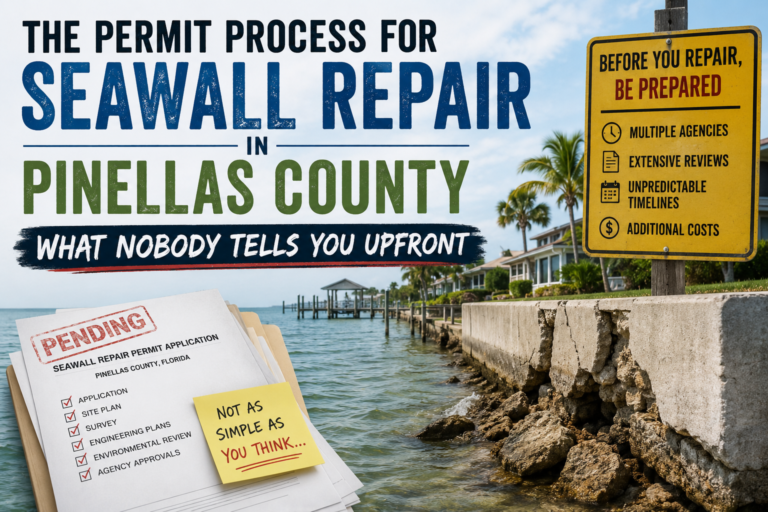
One more factor that surprises people: permitting. Replacing a seawall in Pinellas County involves permits from the county and often the state, and that process takes time. Starting the conversation with a contractor before the wall is in crisis gives you options, including timing the work for the dry season. Waiting until the wall fails can mean emergency permitting, emergency pricing, and a yard that is actively eroding while you wait.
For a complete framework on deciding between seawall repair and replacement, including the 50 percent rule contractors use, see our 2026 guide.
How to Squeeze the Most Years Out of Your Seawall
You cannot change what your wall is made of or how it was installed, but you can influence where it lands in its expected range. Check weep holes twice a year, once before hurricane season and once after. Keep the cap sealed and intact, because it ties the whole top of the system together and keeps water from pouring down behind the panels. Do not let heavy equipment, dumpsters, or loaded trailers sit right at the edge of the wall, because that weight adds load it was never designed to carry. And after every major storm, walk the wall and the yard behind it before you assume everything is fine.
Get a professional inspection every few years, or immediately if you notice movement, new cracking, or soil loss. A contractor with a probe rod and an honest eye can tell you in one visit roughly where your wall sits in its lifespan and whether you are looking at maintenance, repair, or replacement planning. Walls do not last forever, but the ones whose owners pay attention last a lot longer than the ones whose owners do not.
Talk to a Local Seawall Expert
Every wall has its own story, and general lifespan numbers only go so far. If you are wondering where your seawall stands, whether a repair is worth it, or what replacement would actually cost on your property, talk to someone who walks these walls every day. Call (727) 316-5675 for a local opinion on your seawall’s condition and your options.
Q: How can I find out how old my seawall is?
A: Start with your property records and any permits on file with Pinellas County, since seawall construction usually required a permit. Your home inspection report from when you bought the house may note the wall’s material and estimated age. If those come up empty, a local seawall contractor can usually estimate the age within a decade by the material, construction style, and hardware.
Q: Does homeowners insurance cover seawall replacement at the end of its life?
A: Generally no. Standard homeowners policies treat seawalls as excluded structures, and they do not cover wear and tear or gradual deterioration, which is what end-of-life failure is. Some policies cover sudden damage from a named storm, which is different from age-related failure. Check your policy language and talk to your agent before you assume anything is covered.
Q: Can a seawall last longer than its expected lifespan?
A: Yes, and many in Pinellas County do. The expected ranges are averages for typical conditions. A wall with excellent drainage, quality installation, sheltered canal exposure, and an owner who kept up with maintenance can outlast its expected range by a decade or more. The reverse is equally true. Poor drainage or a bad installation can cut a wall’s life in half. The material sets the ceiling, but everything else decides where you land under it.
Q: Should I replace my seawall before selling my waterfront home?
A: It depends on the wall’s condition and your market. A failing seawall is one of the first things a buyer’s inspector flags on a waterfront property in Pinellas County, and it can kill a deal or trigger a big price reduction. If your wall is near the end of its life but still structurally sound, you may be fine disclosing its age and letting the buyer plan. If it is actively failing, replacing before listing usually pays for itself in sale price and deal certainty.