Seawall Cracks in Pinellas County: What Each Crack Means and When to Act (2026 Guide)
Why Concrete Seawalls Crack in Pinellas County
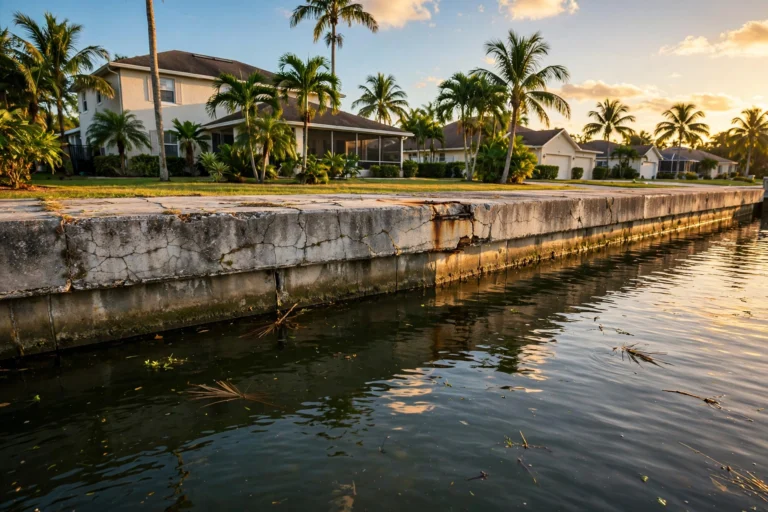
Walk to the water behind almost any canal home in Pinellas County and look closely at the seawall. You will probably find a crack: a faint hairline in the cap, a vertical split down a panel, or a patch where the concrete has flaked away and left a rusty streak. Seawall cracks here are not a question of if. They are a question of which kind, how bad, and how fast they are getting worse. A hairline shrinkage crack is a maintenance item, while a diagonal crack with soil washing through it is a structural warning.
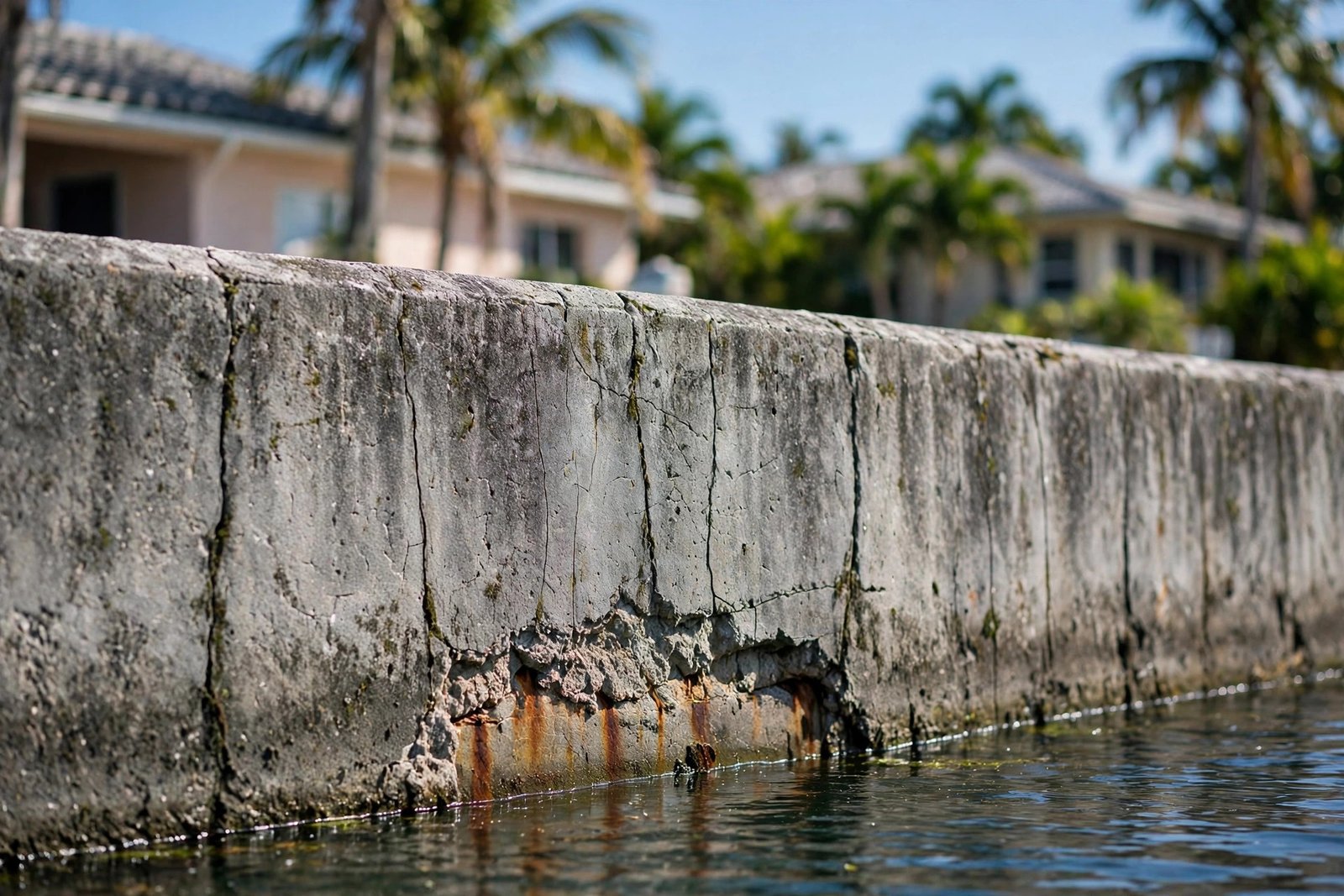
Concrete looks solid, but it is porous. Tiny passages in every panel and cap spend decades filling with salt water from Boca Ciega Bay, the Intracoastal Waterway, and the Gulf canals of Clearwater, Indian Shores, and St. Pete Beach. Salt water carries chloride deep into the concrete, the enemy of the steel rebar hidden inside. Once that protection breaks down, the steel starts to rust. Rust swells to several times the volume of the original steel, and that swelling pushes outward until the concrete splits. Left alone, the crack widens, the concrete flakes off in a process called spalling, and the exposed steel rusts faster.
Salt is not the only cause. Water pressure builds behind the wall after heavy rain, especially when weep holes clog, and soil settling behind older walls cracks panels that lose support at the base. Hurricane Helene pushed record water against Pinellas County walls in 2024, and many cracks that appeared afterward started during that storm. Most local concrete walls were built in the 1960s, 1970s, and 1980s, and a concrete seawall typically lasts 30 to 50 years, so many are now at or past that range.
Seawall Cracks You Will See in Pinellas County
Not every crack is the same. Here are the four patterns that show up most often on local walls.
Hairline Cracks
A hairline crack is thinner than a credit card, usually less than a sixteenth of an inch wide, and most often found in the cap, where the concrete shrank slightly as it cured. Most are cosmetic. They do not mean the wall is failing, and they do not need an emergency call. They do need watching, because a hairline crack is an open door for salt water. Photograph it and check it again in a few months.
Vertical Cracks
A vertical crack runs straight down a panel, often from the cap toward the waterline. Short ones in the cap are common and often trace back to shrinkage or a cold joint where two pours met. A vertical crack that runs the full height of a panel, or keeps getting longer, is a different matter. It usually means the panel is flexing under soil pressure or that corrosion is splitting the concrete along a line of rebar. Vertical cracks that leak water or show rust staining are active damage, not wear and tear.
Horizontal Cracks
A horizontal crack runs sideways across a panel, often at or just above the waterline, where the wet and dry cycles are hardest on the concrete. They deserve more respect than vertical ones. They frequently follow a line of horizontal reinforcing steel, which means corrosion is running along the bar and splitting the concrete above it. A horizontal crack with spalling along its length is a clear sign the steel inside has lost a meaningful amount of section, and these cracks are also the pattern most often tied to panels bowing outward.
Diagonal Cracks
A diagonal crack runs at an angle across a panel or the cap, and it is the pattern most closely tied to movement. It shows up when one part of the wall shifts, a tieback lets go, or soil washes out from behind a section and leaves it unsupported. A diagonal crack that is wider at one end than the other, or one paired with a step where one side sits forward of the other, is a strong signal that something is moving. Get a professional inspection promptly, because movement is the one thing a surface repair cannot fix.
Spalling, Rust Stains, and Exposed Rebar
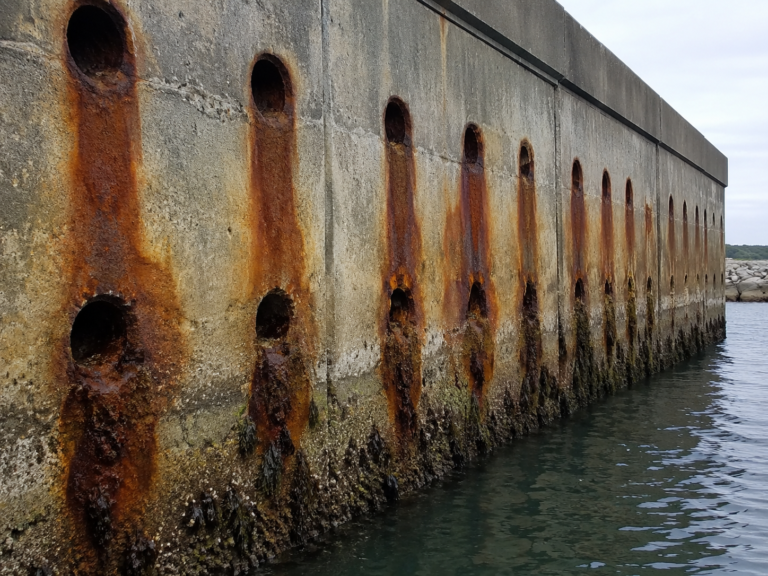
Spalling is the stage where cracking turns visible and physical. It starts as a small flake or chip missing from the face of a panel or the edge of the cap, and as the rusting steel inside keeps expanding, larger pieces break away. In advanced cases you can see the steel itself, orange and pitted, in a hollow where concrete used to be.
Before concrete spalls, it usually warns you with rust stains. Orange or brown streaks are the most reliable early warning a seawall gives: steel inside the wall is already rusting, and water is carrying the rust out through a crack or a pore. Exposed rebar is the next stage. Steel you can see has already lost cross section to rust, so it carries less load than it was designed to carry and rusts faster now that it is open to the air.
Patching the surface without treating the steel underneath is a short term cosmetic fix. A proper repair removes the loose concrete, treats the steel, and rebuilds the section with marine grade repair mortar. Our guide to seawall cap repair in Pinellas County covers what that process looks like when the damage is in the cap.
How to Tell Whether a Crack Is Serious
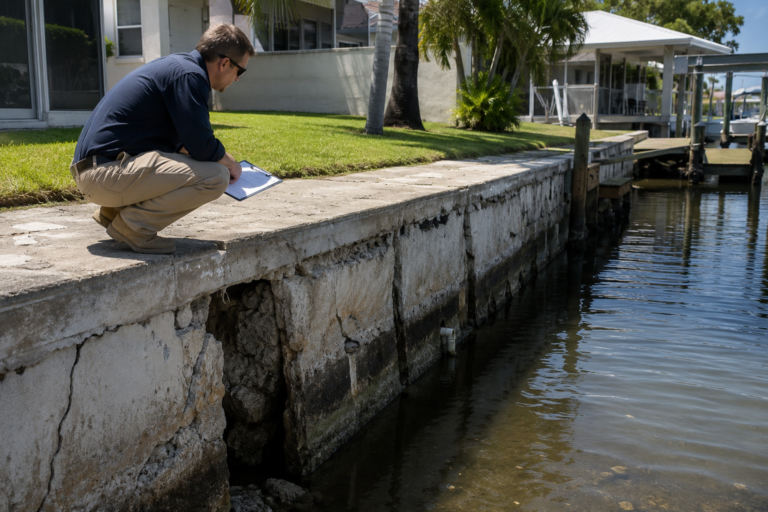
Any crack wider than a quarter of an inch needs prompt professional attention, because a quarter inch gap is wide enough for salt water and sand to move freely in and out of the wall. A narrow crack that is growing is more worrying than a wider crack that has sat unchanged for years. The simplest tool you own is a phone camera. Walk the wall at low tide, when the most concrete is visible, photograph every crack with a coin beside it for scale, and take the same shot again in three months.
Watch what comes through the crack. Clean water after a rain is usually drainage finding a path, but water carrying sand or soil means backfill is washing out through the wall. Check for movement by sighting along the face of the wall: a leaning panel, a cap line that steps up or down at a joint, or a crack with one side offset from the other all point to structural movement. Check that your weep holes are open and draining, since clogged weep holes raise the water pressure behind the wall. Our seawall inspection checklist for Pinellas County homeowners walks through a full set of checks, so you can judge the whole wall instead of one crack in isolation.
How Seawall Cracks Get Repaired
For hairline and narrow dormant cracks, the standard fix is epoxy injection. The crack is cleaned, ports are set along its length, and resin is pumped in until it fills the crack through the full depth of the concrete. Once cured, it bonds the two sides together and seals out water.
Surface patching handles spalled areas and shallow damage. The loose concrete is chipped away to sound material, the exposed steel is cleaned and coated with a corrosion inhibitor, and the area is rebuilt with marine grade repair mortar. The key step is the steel treatment: a patch laid over rusting steel will pop off again, because the rust keeps expanding underneath it.
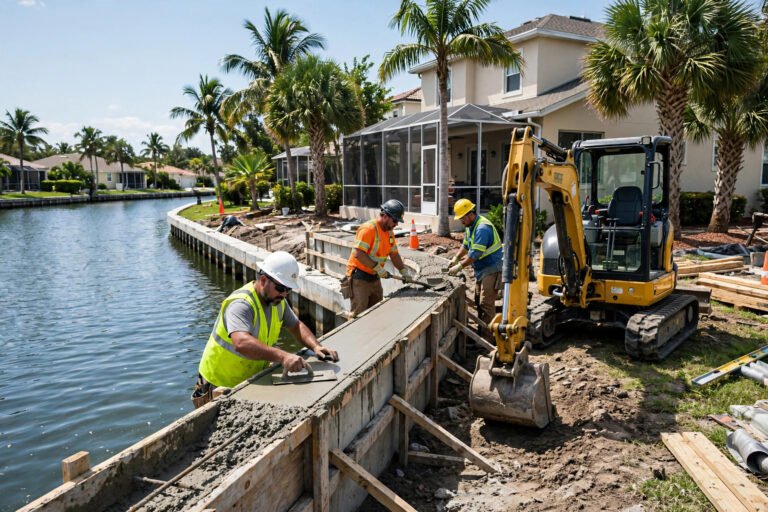
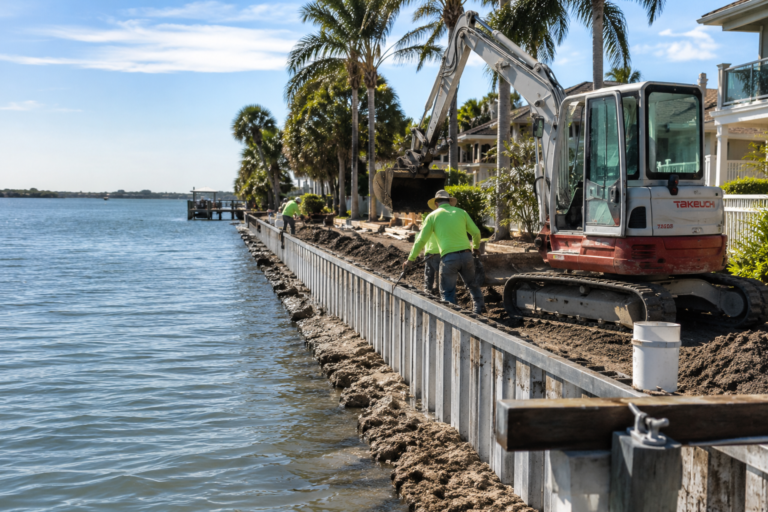
When damage runs deeper, the repair becomes structural. A cap or panel section that has spalled badly or cracked through is rebuilt with new forms and rebar: the damaged concrete is removed, new steel is tied into the existing reinforcement, forms are set, and new marine grade concrete is poured. If soil has washed out through cracks or open joints, foam injection fills the voids and creates a water cutoff behind the wall. When a panel has cracked through, bowed, or lost its steel to corrosion, individual panel replacement is the honest answer.
What Crack Repair Costs in Pinellas County in 2026
Costs vary with wall length, access, and how much wall is affected, so treat every number here as a planning range as of 2026, not a quote. Crack and joint sealing typically runs $100 to $150 per linear foot, and panel patching and spalling repair runs about $120 to $200 per linear foot. Small crack injection jobs commonly total $500 to $5,000. Cap repair runs roughly $150 to $400 per linear foot. Replacing one to three failed panels commonly runs $5,000 to $25,000 per panel. A full replacement runs about $450 to $700 per linear foot for a vinyl wall with a concrete cap in the Pasco and north Pinellas market.
A $1,500 crack injection today can prevent a $40,000 panel replacement in three years, because every season a crack stays open is another season of salt water reaching the steel. Get three written quotes for the same scope of work, and make sure each names the repair method, not just a price.
Repair or Replace: Making the Call
It comes down to how much of the wall is affected and whether the structure behind the face is still sound. Repair is the right call when the damage is localized: a handful of cracks, spalling confined to the cap or a few panels, steel that is corroded but still has most of its section, and a wall that is still straight with working tiebacks. A good repair can extend a wall’s life by 10 to 20 years, for a fraction of the cost of replacement.
Replacement starts to make sense when the damage is widespread. If cracks and spalling run along most of the wall, several panels have cracked through or bowed, the steel is heavily corroded in multiple places, or the wall is leaning and losing soil, repairs become a patchwork that costs nearly as much as a new wall without delivering a new wall’s lifespan. Our guide to repair vs replacement in Pinellas County walks through the full comparison, including how to weigh a repair quote against a replacement quote for your specific wall.
Talk to a Local Seawall Expert
If you have found cracks in your seawall and are not sure which ones matter, talk to someone who looks at Pinellas County walls every week. Call (727) 316-5675 for a straight answer about what your cracks mean, what the repairs cost, and whether your wall is a candidate for repair. A short conversation now beats a failed panel.
Q: Are hairline cracks in a seawall a problem?
A: Usually not right away. Hairline cracks less than a sixteenth of an inch wide are often caused by concrete shrinkage as it cured, and they do not mean the wall is failing. They do let salt water in, though, so photograph them, check them again in a few months, and seal them if they grow.
Q: How much does it cost to repair seawall cracks in Pinellas County?
A: As of 2026, simple crack and joint sealing runs about $100 to $150 per linear foot, and panel patching and spalling repair runs about $120 to $200 per linear foot. Small crack injection jobs commonly total $500 to $5,000.
Q: What causes concrete seawalls to spall and crack in Florida?
A: Salt water is the main cause. Chloride penetrates the concrete and corrodes the steel rebar inside. Rust swells to several times the volume of the original steel, which splits the concrete and causes it to flake off in a process called spalling.
Q: When should I replace my seawall instead of repairing the cracks?
A: Repair is usually right when the damage is localized and the wall is still straight with sound tiebacks. seawall replacement makes more sense when cracks and spalling run along most of the wall, several panels have cracked through or bowed, or the steel is heavily corroded.